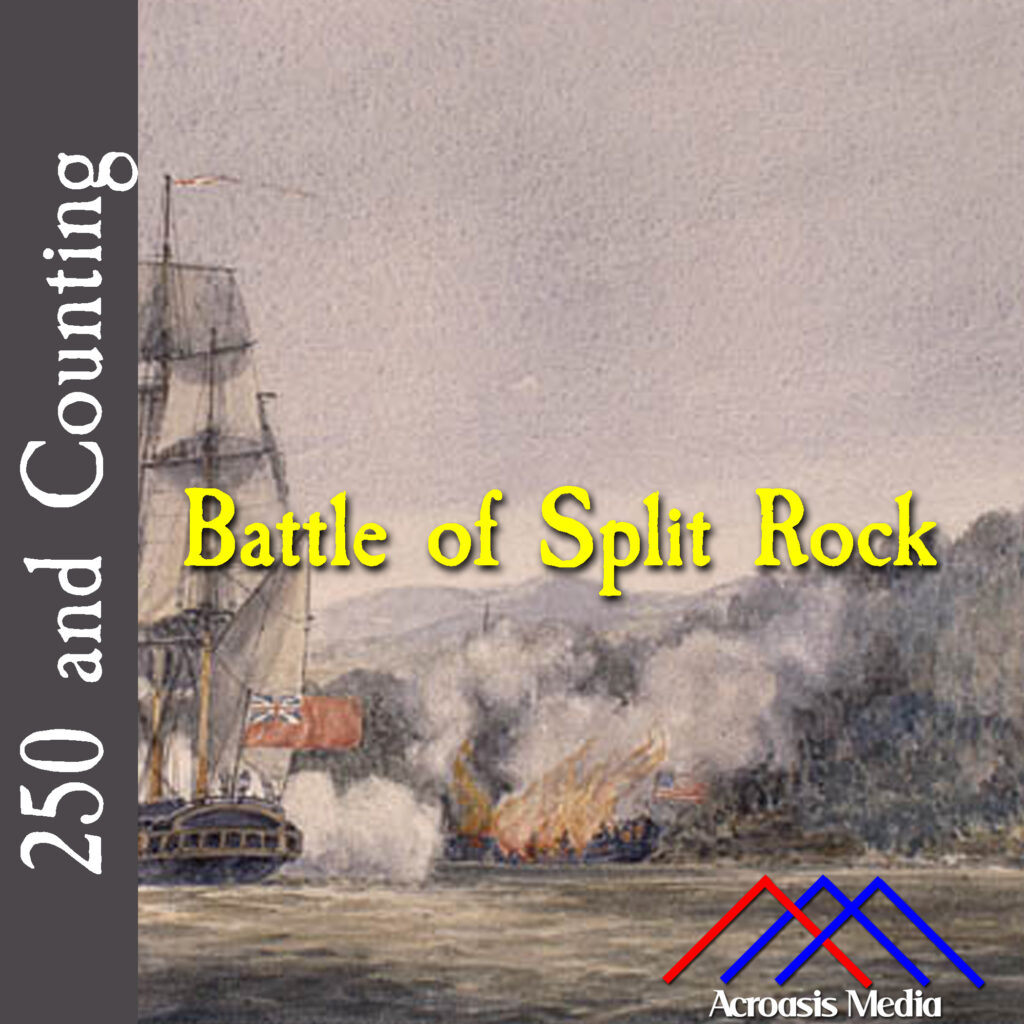
The Battle of Split Rock is really just a continuation of the Battle of Valcour, and a lot of it takes place in a location called Button Mould Bay (or Buttonmold Bay).
So why is it called the Battle of Split Rock?
That’s a fine question. On the western shore of Lake Champlain, just north of Button Mould Bay, is a formation called Split Rock Mountain. It rises sharply from the lake to an altitude of just over 1000 feet, and it’s where the confrontation between the British and the Americans resumed.
Button Mould Bay is an area of shallower water on the opposite side. It gets its name from a series of clay masses which have hardened almost to the point of concrete, into a shape much like an oversize button, or like the molds used in button making. Those concretions actually made it easier for Benedict Arnold to run his ship, and the galleys accompanying him, aground and set ablaze. This was the ship that had all of Arnold’s papers on it that I told you about the other day.
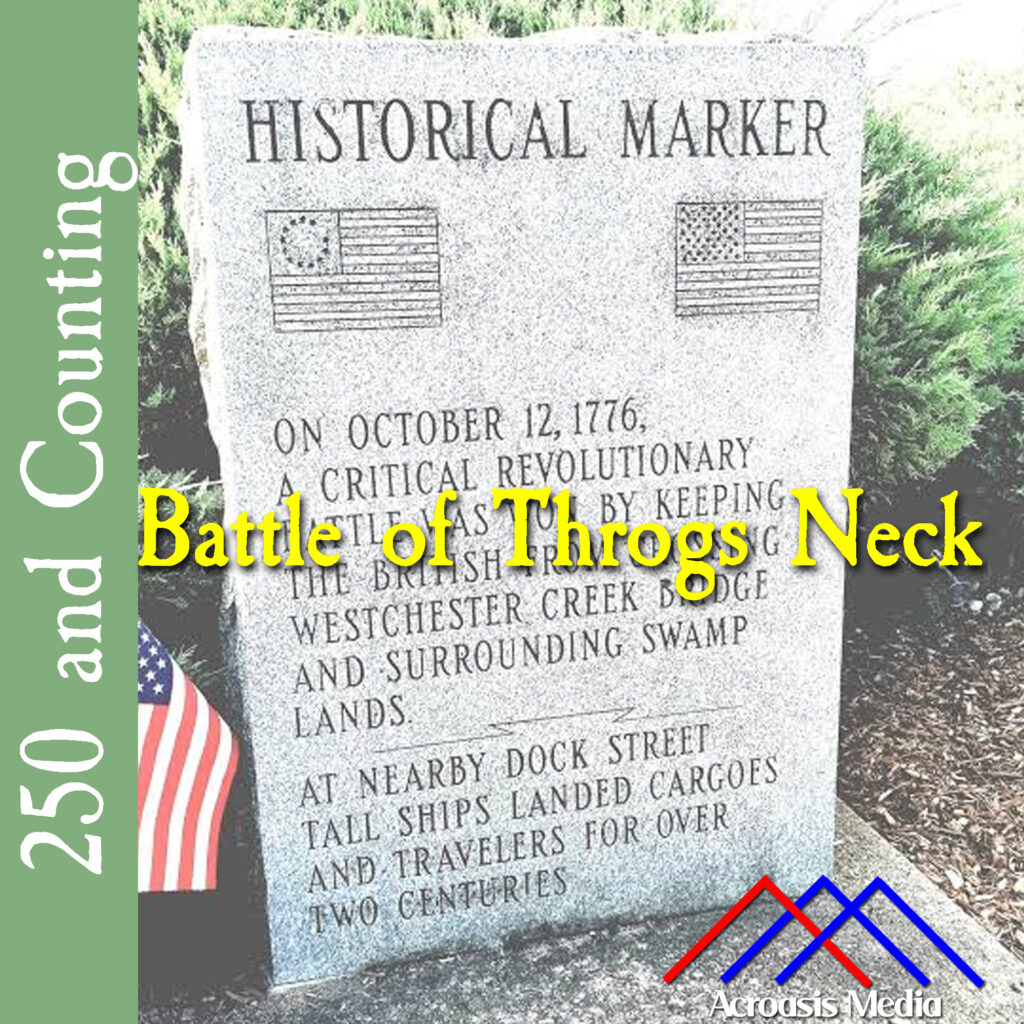
The Battle of Throgs Neck, or Throg’s Point, or a number of other names, was part of a move intended to trap Washington’s forces through flanking them from the north while Washington concentrated on the troops already in front of him on Manhattan Island.
Washington did anticipate that this might happen, and sent American troops that way, but part of the problem that he had was that there were so many possibilities, and he just couldn’t cover them all. So he took a little gamble in sending his numbers to different places and hoping it would be enough.
In the case of Throgs Neck, it was 4000 British troops against 750 Americans, but they handled it in a clever way. They managed to contain the British advance by taking advantage of the local geography, forcing the British to retreat. But this only meant that they’d regroup and try again somewhere else. This led to the Battle of Pell’s Point, of which this battle is usually considered a part, or just a prelude.
As Mike will explain to you in a few days, the Battle of Pell’s Point is technically a British victory, but it also had a separate function that breaks well for the American side.
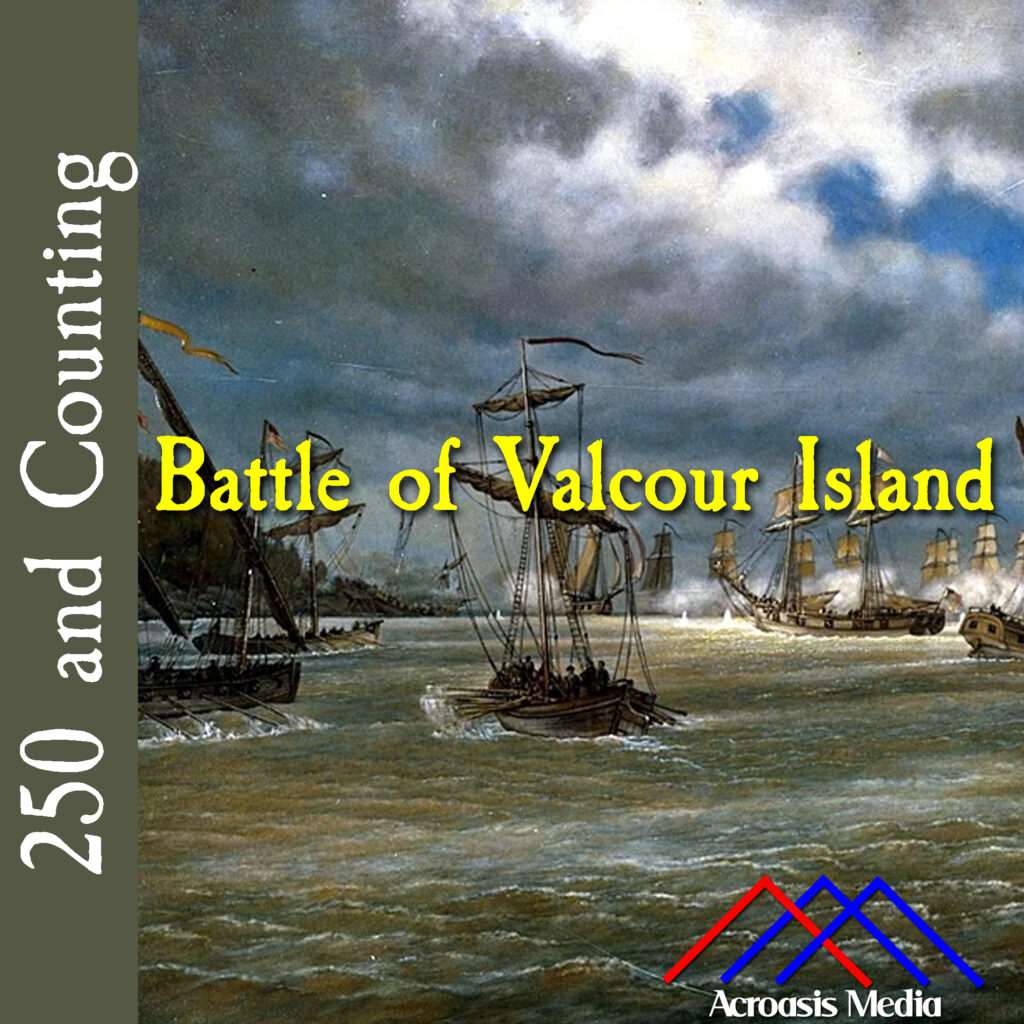
The Battle of Valcour Island didn’t really take place on the island; rather it was in Valcour Bay, a strait between New York and Valcour Island, in Lake Champlain.
After the failed invasion of Quebec the Continental forces retreated south to Fort Ticonderoga, at the south end of Lake Champlain. As they retreated they destroyed materiel they couldn’t use and left it behind in the relatively shallow, relatively narrow lake. This made navigating the lake tough for the British, so they took their time to get more reliable ships to assist with their next move.
That turned out to be a mistake.
As both sides prepared for the next conflict, the Americans scouted the lake and determined that they could effectively steer the British ships into Valcour Bay, where they would have ships waiting to fight them off. In addition, the wind was blowing the “wrong” way for British navigation, making things even tougher. Some British ships actually ran aground near the island but the battle itself was pretty brutal, with ships on both sides being badly hit. One British vessel’s powder magazine was struck and the entire ship exploded.
In the long run, however, darkness began to fall and both sides backed off. The Americans retreated, and the British basically stopped their attack largely because they were getting low on ammunition.
Benedict Arnold realized that Crown Point was no longer a viable defense point, so he destroyed and abandoned the fort, moving the forces to Ticonderoga. The next day, the British took Crown Point and remained there for about two weeks. Unfortunately, cold weather was already settling in and the decision was made to winter back up in Canada.
Remember when I said that taking their time was a mistake? Had they acted more quickly, they’d have beaten the weather AND caught the Americans by surprise. General Carleton and other officers recognized this in hindsight. Hessian commander Baron Riedesel noted, “If we could have begun our expedition four weeks earlier, I am satisfied that everything could have ended this year.”
And in a weird way, this battle was the catalyst for Benedict Arnold turning against the Americans. He’d lost a lot of personal papers during the battle, and when he requested compensation for some of his expenses in and following Quebec, he couldn’t provide documentation. He’d already been secretly negotiating with the British to change alliances (this would have been in late 1779), but that incident pushed him into resigning his command in order to be transferred to West Point, which he’d planned to surrender to the British.
Fortunately his plot was discovered and he fled to New York City, which was still occupied by the British. Eventually he got passage for himself and his family to England. He never set foot in the United States again.
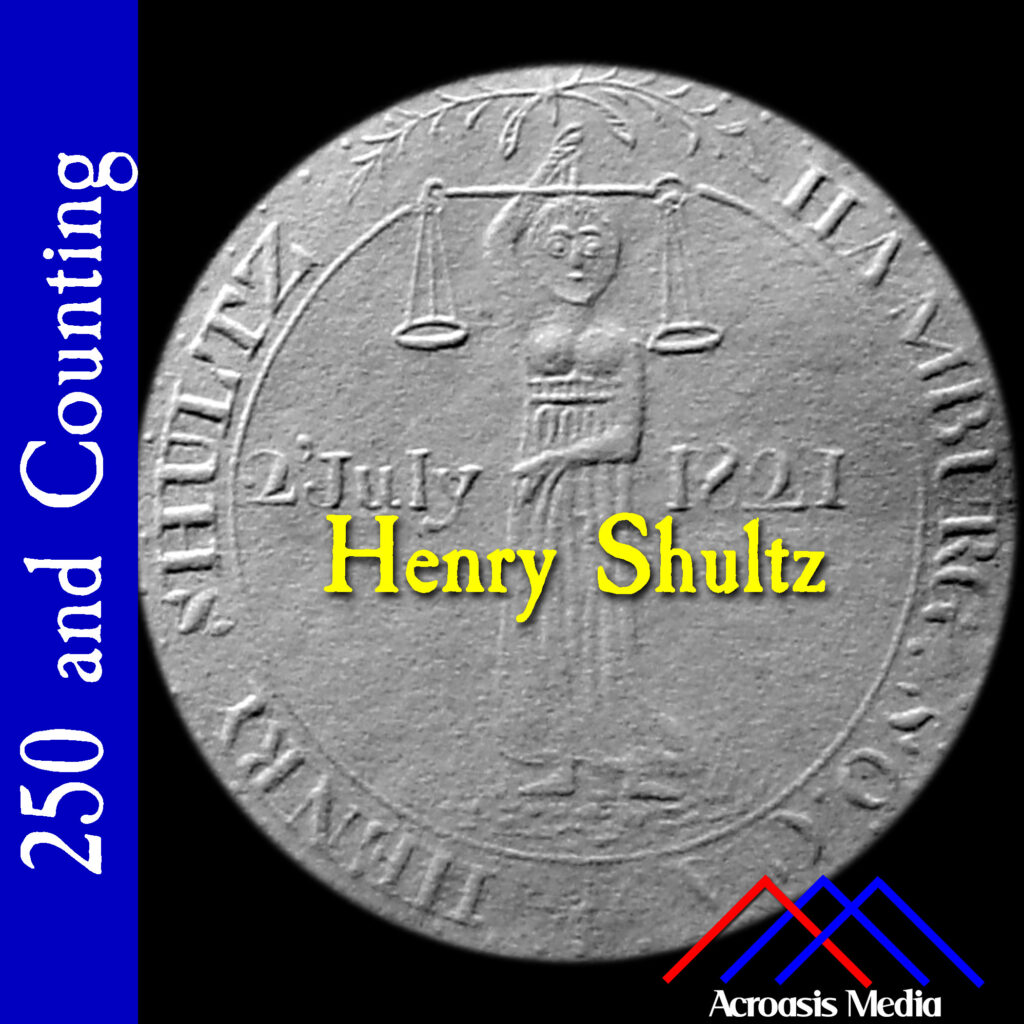
The town created by Henry Shultz turned out to be as ephemeral as the man himself.
Don’t go looking for Hamburg, South Carolina, because you’ll be sorely disappointed. At best what remains is a ghost town, unoccupied since 1929 after several floods came through. Perhaps the most notable one was in 1911, after which nearby cities built levees to protect themselves, but there wasn’t enough of Hamburg remaining at that point to bother building one there.
For all that, Hamburg was a very big deal in Henry Shultz’ day. It was a little bit of a spite project on his part, meant specifically to compete with Augusta, Georgia, on the other side of the Savannah River. And for a long while it did quite well, largely because it was the terminus of a railroad line. But further expansions of the railroads and the completion of the Augusta Canal added up to a big drop in cargo passing through, and that was the beginning of the end.
If you visit North Augusta, you can see a road bridge across the river, which is in the same place as the bridge Mike discusses in the episode. Parallel to that bridge you’ll see some broken piers, which are remnants of the South Carolina Rail Road, which operated in that area until 1908.
It took a month to figure it out, but the British ship movement up the Hudson River was a sign that they’d finally decided how they were going to implement their plans.
Rather than concentrating on New York City, which was going to be problematic because George Washington’s troops were pretty dug in over in Harlem Heights, Admiral Howe made the choice that ran closer to the original plan: start sending warships up the Hudson and establish a new foothold in the Pelham area of what we now call the Bronx. This could then become a base of operations for moving further up the Hudson Valley and make it very difficult, if not impossible, for materiel and information to pass between New England and the rest of the states. And since New York had a pretty sizeable chunk of Loyalists there, the downstate area should be fairly easy pickings.
So the British ship movement came as a surprise to nobody on the American side; what probably did come as a surprise was that it wasn’t as difficult to get through as they probably hoped they’d made it.
Washington and his War Council did plan for this possibility and there will be troops waiting when the British make their landing. We’ll talk about that in a few days.
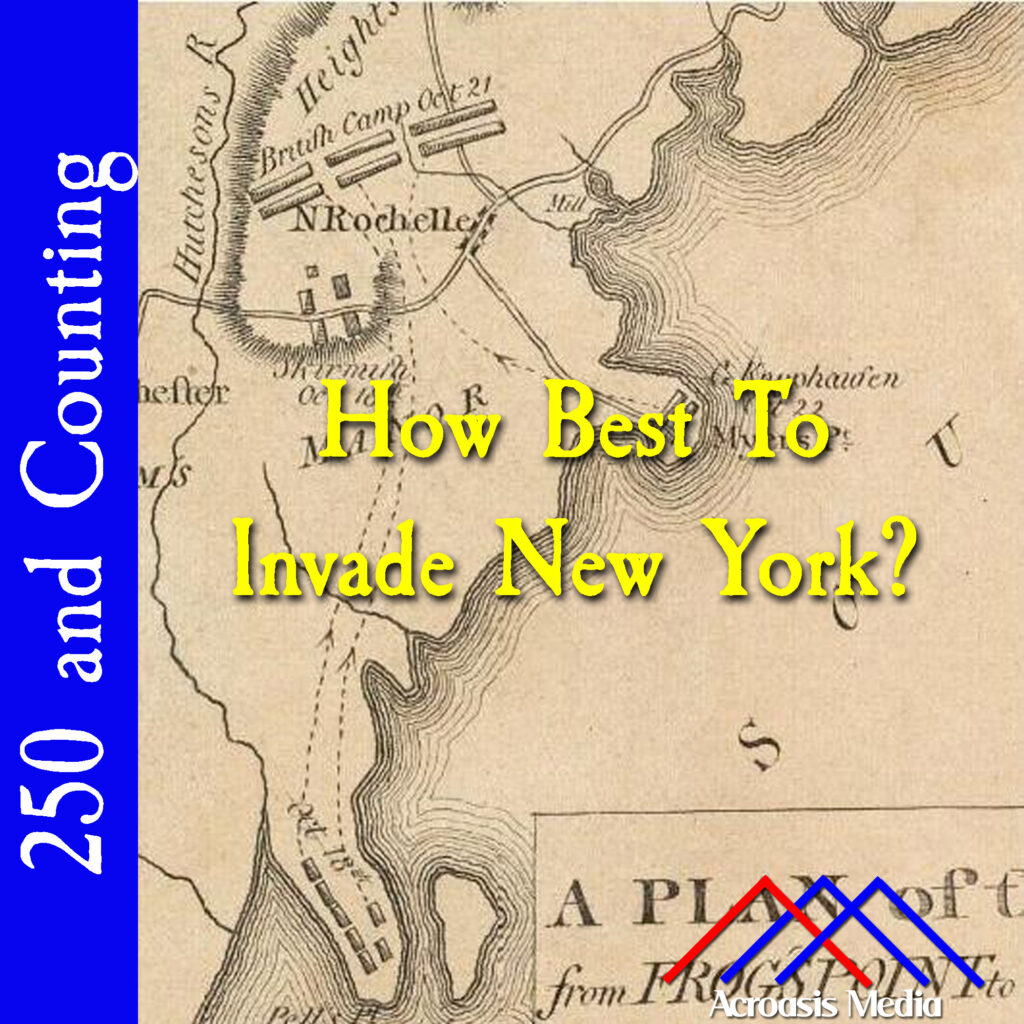
There are several names for the battle about to happen here, depending on how you view the geography; Battle of Throgs Neck, Battle of Throgs Point, Battle of Pells Point and believe it or not that isn’t even half of the total names given to this one conflict.
After George Washington’s successful defense of Harlem Heights, which was a good place to be from a defensive standpoint, the Continental and British armies were basically in a stalemate for a few weeks.
The Americans were under the impression that the British would either attack Fort Washington, or make a flanking move through the Long Island Sound. Washington’s Council of War finally tried to guard against both possibilities (because this worked out so well when the British invaded Long Island…ugh). Ten thousand men remained to defend Harlem Heights and Fort Washington, while General William Heath took five thousand troops to the far side of the Hudson, near Fort Constitution and modern-day West Point.
Ultimately General Howe chose a flanking maneuver but came in at a point much further south than Fort Constitution. In just a few days we’ll see how the confrontation works out.
Before I tell you a little bit about the First Virginia General Assembly of 1776 (which I do have to differentiate with a date, so it’s not confused with the First Virginia General Assembly of 1619), I wanted to spend a moment on the show’s cover artwork.
For some reason it was in putting today’s art together that I noticed the strong similarity between today’s artwork and yesterday’s. Perhaps it’s because they’re both buildings, even though today’s structure is much larger then yesterday’s. That, of course, is because I size it to fit the frame,
But it had me looking back on other artwork I’ve used (and, in two cases, created somehow) in the past, and of course there’s a lot of similarity among cover art pieces, largely because so many of them are portraits, and there’s a similarity in the way that people posed, and dressed, and so on. I’m sure another part of it is that I’ve done all of them, and so it’s my aesthetic that’s going into the cover art.
In 645 episodes to date, I’ve only repeated images a few times, and I’m rather proud of that track record. In one case it’s because there really was only one useable image available. There have been maps, and photographs, and stamps, and historical markers, and buttons, and official seals or flags, and documents, and once I used AI just for the laughs, and another time, just a few weeks ago, I did a little photoshop chicanery, again to amuse myself. Each time I tried to note the source of the artwork in the alt text, and the one time I didn’t, I was (rightly) called out for it by the guy who took the photo. He and I had a very pleasant exchange about it and I think it ended positively.
My point (I do have one, thanks for asking) is that even though this podcast doesn’t have a gigantic following, I do put some thought into stuff like this, and I hope that the efforts that Mike and I put into the show overall are evident.
I promised to spend some time talking about the First Virginia General Assembly of 1776, so here goes: during the episode I mentioned four big moves that they made in the relatively short period that they were convened. It’s worth noting that at least two of them were heavily influenced, or drafted by Thomas Jefferson. First was the abolition of entail. Entail was a rule that went back to the English feudal rules, which basically prevented the aristocracy from breaking up or selling off estates. Abolishing this rule helped to unravel the foundation of a landed aristocracy.
The other big one attributed to Jefferson was the Committee of Revisors, of which Jefferson was a member. It was recognized that the old Colonial Codes were based on royal laws which were outdated (like entail), and someone had to go through the entire legal code to redraft it into something that would work for a (small-r) republican system of government. It took them several years to get the job done, but the work began right away.
It’s possible that the assembly’s abolition of taxes for non-Anglican churches was also Jefferson’s work, and his later “Virginia Statute for Religious Freedom” was first introduced at this time, but that wasn’t enacted for several years. The other action related to freedom of religion during this period was the suspension of salaries for Anglican ministers, which did major damage to the state-based church system. (Remember, compulsory separation of church and state was still several years in the future.)
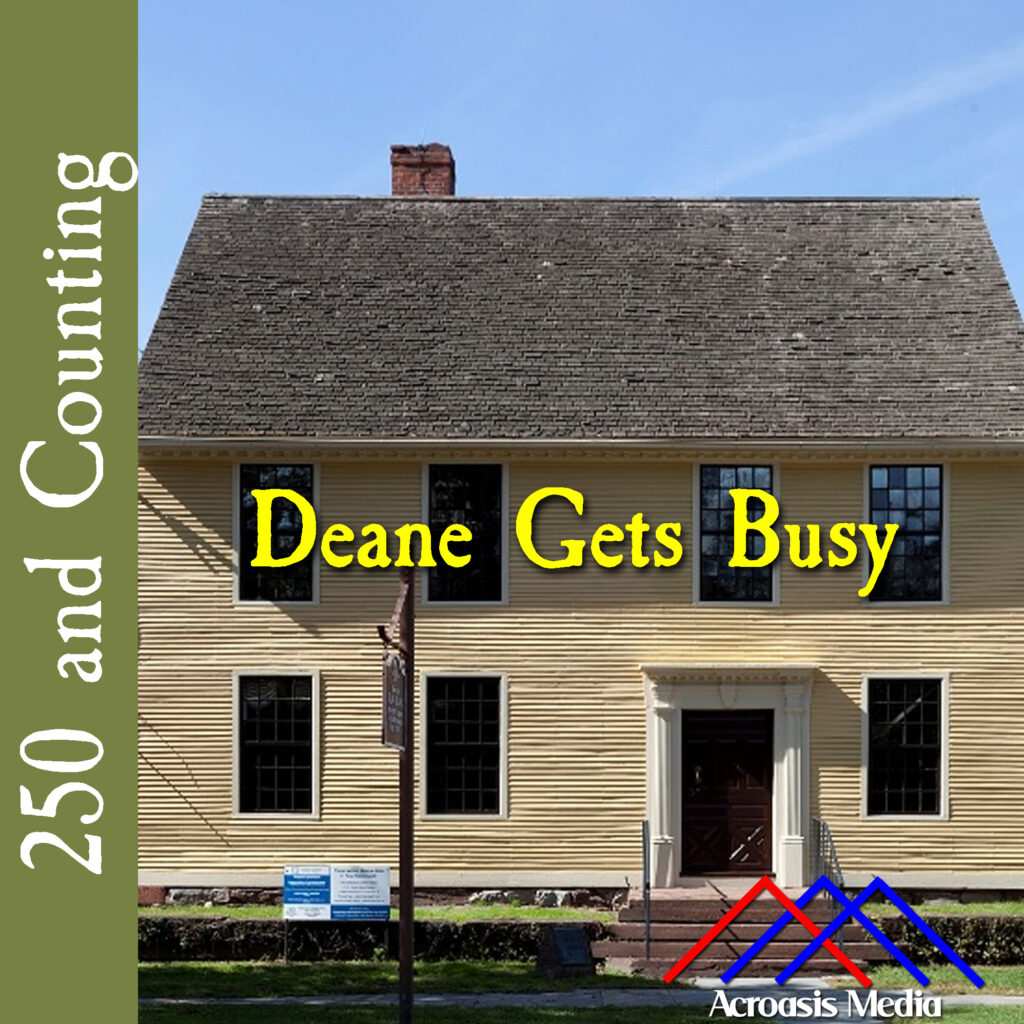
We’ve talked so much about Silas Deane that I don’t have much new to share in this space, so I’ll tell you a little about his house.
The house in today’s cover art was completed in 1769. It’s located in Wethersfield, Connecticut. The facade is asymmetrical because there was a porch at one time.
Deane designed the house specifically to impress people and to project an image of power. It has two parlors: one for entertaining and one for family dining, and the kitchen is oversized specifically to allow for preparation of larger meals when there were guests.
Elizabeth Deane entertained important people when Silas was away for one reason or another, whether it was performing his Congressional duties or engaging in diplomatic missions overseas, as he was during this episode. Among those VIPs would be John Adams and George Washington, on separate occasions. Elizabeth died in 1777, while Silas was still in Paris.
After Deane’s death overseas in 1789, house and possessions were sold to satisfy his creditors. It passed through many different owners until 1874, when the Fenn family took it over. Then in 1938 they bequeathed the house to the National Society of the Colonial Dames of America, and it’s been a historic site for visitors since then.
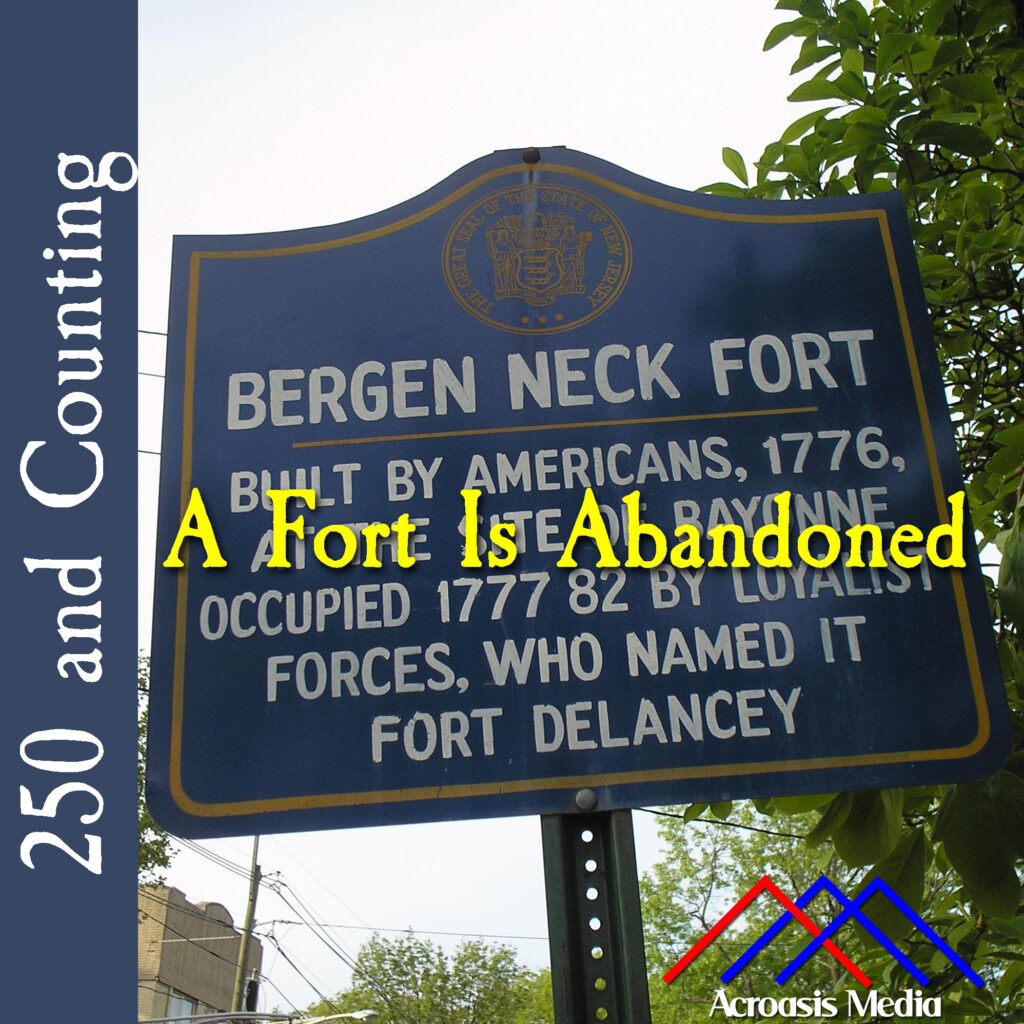
The cover art for today’s episode is the historical marker for Bergen Neck Fort, in Bayonne, New Jersey.
As someone who was born and raised on the other side of the East River, it’s supposed to be my duty to bust on New Jersey and say something like “there’s nothing interesting going on in Bayonne” and I’d mostly be right, but I will note that Mercer Park, just a hair under a mile from this spot, is rather nice.
I did spend a few years living in northern New Jersey, just a stone’s throw from what was then called The Meadowlands (and still is, if you’re a die-hard), and it’s really not a bad place to live. I had a decent sight-line to the Manhattan skyline, but my neighborhood had a very suburban feel to it. The town I lived in was practically Whoville during Christmas season.
Bergen County was also home to many people who lost their lives to the attacks on the World Trade Center, since it was just across the Hudson River, so there are numerous memorials in the area. Lyndhurst, NJ (for example), which is mostly famous for a bunch of exterior scenes from The Sopranos, has one that’s made from stones reclaimed from the rubble. I moved away from the area just a couple of weeks before September 11, but I kept in touch and many people in the area were deeply affected.
And now that I think about it, Bayonne—which is literally within sight of the former WTC buildings and the Statue of Liberty— has a truly moving memorial commonly called “The Teardrop”, which was a gift to the United States by a Russian sculptor named Zurab Tserteli. At 100 feet high, it can actually be seen from the other side of the river as well. So don’t go to Bayonne to see Bergen Neck Fort, since there’s nothing there. But if you do go, head to Harbor View Park.
War bonds have been a thing since literally the beginning of the country.
In this particular case, Britain had spent a few years taking as much hard currency (that is, gold and silver) from America as they could, which left us in a pretty bad state when it came to having something to back our money.
The coin used for today’s cover art was actually a Continental Dollar, which was designed by Ben Franklin. Coin dies at that time were hand-punched, which means that because the dies only had so much lifespan to them, a limited number (a few thousand) could be made but the next run would be slightly different from the previous one. There are records of some coins being misspelled, such as this one. Another die has “currency” misspelled as “currencey”.
The Continental Dollar coin also had a little bit of a rebus pun on it. The word “FUGIO” is Latin for “I fly”, referring to the sun and the sundial. Then underneath the sundial is the English phrase “MIND YOUR BUSINESS”. Put it all together and you get, “Time flies, so mind your business.”
Most coins at that time were made of pewter; only about a hundred survive to this day, even though thousands were made. The prevailing theory for this is that most of them were melted down because of wartime demands for the metal.